Fast, Reliable Gate Access Control Across Stanford
Gate access control repair and installation in Stanford typically costs $850–$2,400 for residential faculty housing and $3,500–$8,500 for institutional systems tied to campus networks, with most service calls completed same-day once vendor clearance is obtained. Sierra Gate Repair San Diego dispatches to Stanford regularly from our San Diego base, and Frank Delgado’s team understands the vendor credentialing and IT coordination that Stanford’s university-owned properties require. Call (855) 671-2951 for a free estimate — we’ll walk you through the approval process so nothing gets held up.
Stanford isn’t a conventional town. Nearly every acre sits on university land, and that changes how gate work gets done. Whether you’re in a faculty lease on Mayfield Avenue, managing graduate housing near Escondido Road, or overseeing access for a research quad off Campus Drive, your gate system likely ties into Stanford’s broader security infrastructure. We’ve spent 20 years solving gate problems that generalists haven’t encountered, and we’ve learned that getting the job done right here means respecting those institutional layers from the first phone call.
Why Sierra Gate Repair San Diego Is Stanford’s Preferred Gate Access Control Company
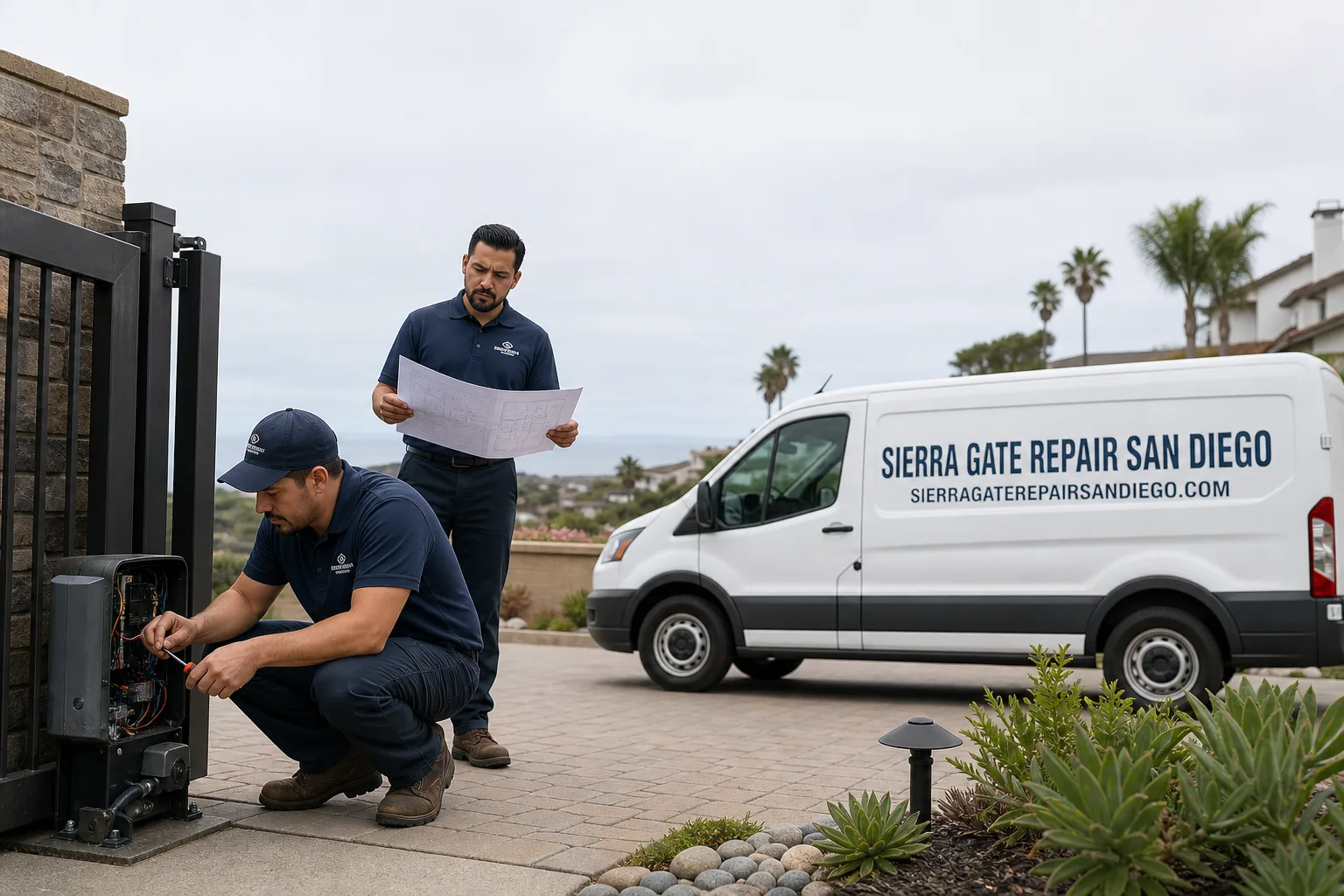
Our reputation in Stanford has grown through word-of-mouth among faculty and facilities staff who’ve seen the alternative. Frank Delgado still runs the jobs personally — you get 20 years of focused gate expertise, not a subcontractor figuring it out on your dime. That matters when a card-reader integration fails and you need someone who can diagnose whether it’s the reader, the control board, or the campus network handshake.
We’ve earned 375 verified reviews averaging 4.9 stars across our service territory. Stanford customers specifically mention our patience with procurement protocols and our ability to coordinate with Stanford R&DE and IT without creating more work for them. One facilities manager on the south side of campus put it plainly: “They knew who to call before I did.”
Response time to Stanford depends on vendor credentialing status, which we help expedite. Once cleared, we’re typically on-site within 24–48 hours for standard calls, same-day for access-control failures that compromise security or safety. We know the local conditions: the rain-shadow corrosion, the eucalyptus debris, the mid-century ranch gates that have been retrofitted three times. That local knowledge saves diagnostic time and prevents callbacks.
Our Gate Access Control Services in Stanford
Card Reader Systems
Card readers are the backbone of Stanford’s controlled-access environment, from faculty housing enclaves to research quads near SLAC. We install and repair proximity readers, smart-card systems, and multi-technology readers that bridge legacy campus credentials with newer standards. Because Stanford’s IT and Security departments maintain the master access database, any card-reader replacement or reprogramming requires coordination through proper channels — something we’ve done enough times to know the contacts and protocols. A typical card-reader installation or major repair in Stanford faculty housing runs $1,200–$2,800; institutional-grade systems with custom integration start around $4,500.

Video Intercom Entry
Video intercoms add visual verification to gate access, which matters for faculty homes that receive deliveries, visiting scholars, or service personnel. We install stand-alone systems and integrate with existing campus security networks where architecture allows. Stanford’s Romanesque Revival sandstone buildings, particularly around the Main Quad, often require surface-mount or custom-finish hardware that doesn’t compromise historic aesthetics. We’ve sourced heritage-style intercom housings that blend with ornamental ironwork rather than fighting it. Video intercom installations in Stanford typically range $1,800–$3,200 for residential, $3,500–$6,000 for multi-tenant or institutional entry points.

Phone Entry Systems
Phone entry systems let residents grant access remotely, whether through landline integration or cellular-based call routing. In Stanford’s graduate housing clusters and multi-family units, these systems reduce the administrative burden of key distribution and re-keying. We work with cellular entrants that don’t require hardwired phone service — increasingly important as copper-line infrastructure ages. Phone entry system installation or replacement in Stanford generally runs $1,400–$2,600, with cellular models at the higher end of that range.

Remote Control & Keypad Entry
Remote controls and keypads remain practical for standalone gates not tied to campus networks, or as backup access methods for systems that are. We program multi-code keypads with audit-trail capability and source replacement remotes for operators going back 15+ years. For faculty homes with original mid-century gates, we often retrofit modern access control without replacing the gate itself — a significant cost savings when the ironwork and masonry are sound but the electronics have failed. Keypad or remote-system work in Stanford typically runs $650–$1,500 for repair or reprogramming, $1,100–$2,200 for new installation with operator integration.

What happens when you call
- 1
A real person answersNo phone trees — you reach a local pro.
- 2
You get an upfront price rangeHonest numbers before anyone is dispatched.
- 3
A background-checked tech heads outLicensed & insured, dispatched right away.
- 4
You approve before work beginsNothing starts until you say go.
Trusted Brands We Service in Stanford
We carry deep familiarity with nine major gate operator brands, and for Stanford’s mix of institutional and residential systems, we most commonly service FAAC and BFT on the commercial side — both European manufacturers with robust access-control integration that Stanford facilities specify for high-cycle applications. Linear and Viking appear frequently in faculty housing retrofits where American-made support infrastructure matters. Our parts relationships and in-house welding capability mean we can fabricate mounting brackets or repair corroded housings on-site rather than waiting for specialty orders. That matters in Stanford, where a gate down for two days can mean missed deliveries, compromised research access, or security protocol violations.
Common Gate Access Control Problems We See in Stanford Homes
- Winter corrosion on card-reader terminals. Stanford’s rain shadow still delivers concentrated wet-season moisture November through March. We’ve replaced dozens of control boards where moisture intrusion caused intermittent card-reader failures that campus IT couldn’t diagnose remotely — the reader “worked” in dry testing but failed in field conditions.
- Eucalyptus and oak debris jamming underground loops and slide tracks. The Peninsula’s mature canopy drops leaves, bark, and seed pods year-round. Underground inductive loops that detect vehicles for automatic opening get false positives or fail to detect when debris bridges the gap. Slide-gate tracks clog and strain operators. We clean and shield these systems, and we can relocate loops to above-ground ultrasonic or radar detection where the environment demands it.
- Dry-summer warp in wooden gate frames. Faculty housing stock includes original mid-century ranch gates with wood components that shrink dramatically during Stanford’s bone-dry July–October stretch. The gate that latches perfectly in January won’t close in August, and the operator strain damages gearboxes. We address the underlying frame issue rather than repeatedly replacing operators.
- Network integration failures after component swaps. This is the Stanford-specific headache: a technician replaces a motor or control board without notifying campus IT, and the access permissions don’t re-sync. We’ve been called after “simple” repairs locked out entire research zones. Our protocol includes coordination with the right university contacts before we touch networked systems.
Pricing for Gate Access Control in Stanford, CA
Here’s what we’ve actually charged for recent Stanford jobs. These are real ranges, not bait-and-switch come-ons.
| Service | Typical Range in Stanford |
|---|---|
| Card reader repair/replacement (faculty housing) | $1,200 – $2,800 |
| Video intercom installation (residential) | $1,800 – $3,200 |
| Phone entry system (cellular, multi-tenant) | $1,800 – $2,800 |
| Keypad/remote system repair | $650 – $1,500 |
| Keypad/remote new installation | $1,100 – $2,200 |
| Institutional access-control integration | $3,500 – $8,500+ |
| Service call / diagnostic (applied to repair) | $150 – $250 |
What moves the needle: networked versus standalone systems, the extent of coordination required with Stanford departments, custom finish requirements for historic buildings, and whether we can use standard mounting or need to fabricate brackets on-site. Every estimate we provide is free, detailed, and valid for 30 days. Call (855) 671-2951 to schedule.
We Also Serve Cities Near Stanford
Our Gate Access Control team regularly works across the Peninsula, including Palo Alto to the north, Atherton and Los Altos Hills to the west, and East Palo Alto to the east. The same vendor-coordination discipline and brand expertise travel with us, though each municipality has its own permitting landscape. For Stanford specifically, the university’s internal approval process replaces conventional city permitting for most gate work on university land.
Serving Stanford, CA — Our Local Coverage Area
We’re based in the Stanford area and know this community well. Use the map below to see our service coverage — if you’re nearby, we can almost certainly help.
FAQs — Gate Access Control in Stanford
Yes, if the gate sits on university-owned land or connects to campus access-control networks. We guide you through Stanford’s vendor credentialing and help identify the correct R&DE or IT contact before work begins. Call (855) 671-2951 and we’ll explain the specific approval path for your property type — faculty lease, graduate housing, or institutional facility.
Yes, provided we coordinate with Stanford IT and Security during planning and installation. We specify readers compatible with campus credential formats and handle the technical handshake with their access database. Most faculty housing integrations take 2–3 hours of on-site work plus remote database updates; full research-quad systems may require phased implementation to avoid downtime.
Dry-season wooden frame warp misaligning the operator, followed by wet-season corrosion of control electronics. The frame issue is often misdiagnosed as motor failure. We check structural alignment before quoting operator replacement — it’s saved Stanford customers thousands in unnecessary motor swaps. Call (855) 671-2951 for an honest diagnostic.
We source heritage-compatible hardware and coordinate with Stanford’s facilities preservation standards. For sandstone Romanesque Revival settings, we use ornamental iron and bronze-finish hardware that matches existing architectural character rather than installing utilitarian modern components that clash. R&DE approval is required for any visible modification; we prepare submission documentation as part of our service.
Standalone battery backup systems keep basic keypad and card-reader functions active for 24–72 hours depending on cycle frequency; networked systems may lose real-time database verification if campus network infrastructure also loses power. We assess your specific risk profile and can recommend battery sizing or manual override options appropriate to your security requirements. For a specific recommendation, call (855) 671-2951 — estimates are free.
Written by Frank Delgado, Owner at Sierra Gate Repair, serving Stanford and the Peninsula with 20 years of dedicated gate expertise.