5 Mistakes to Avoid With Gate Parts & Welding
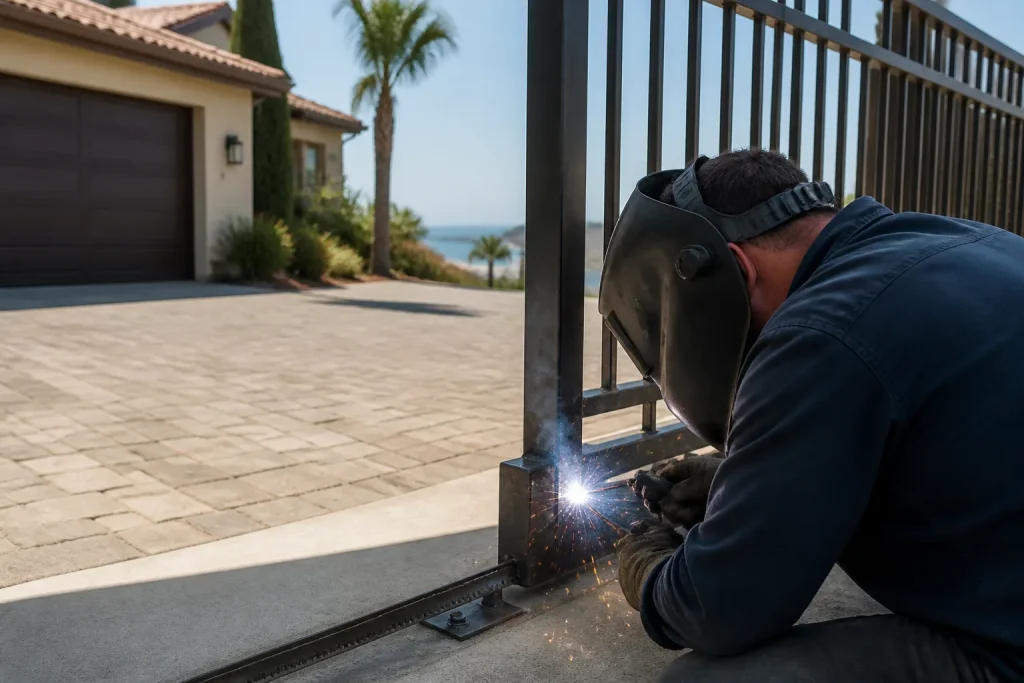
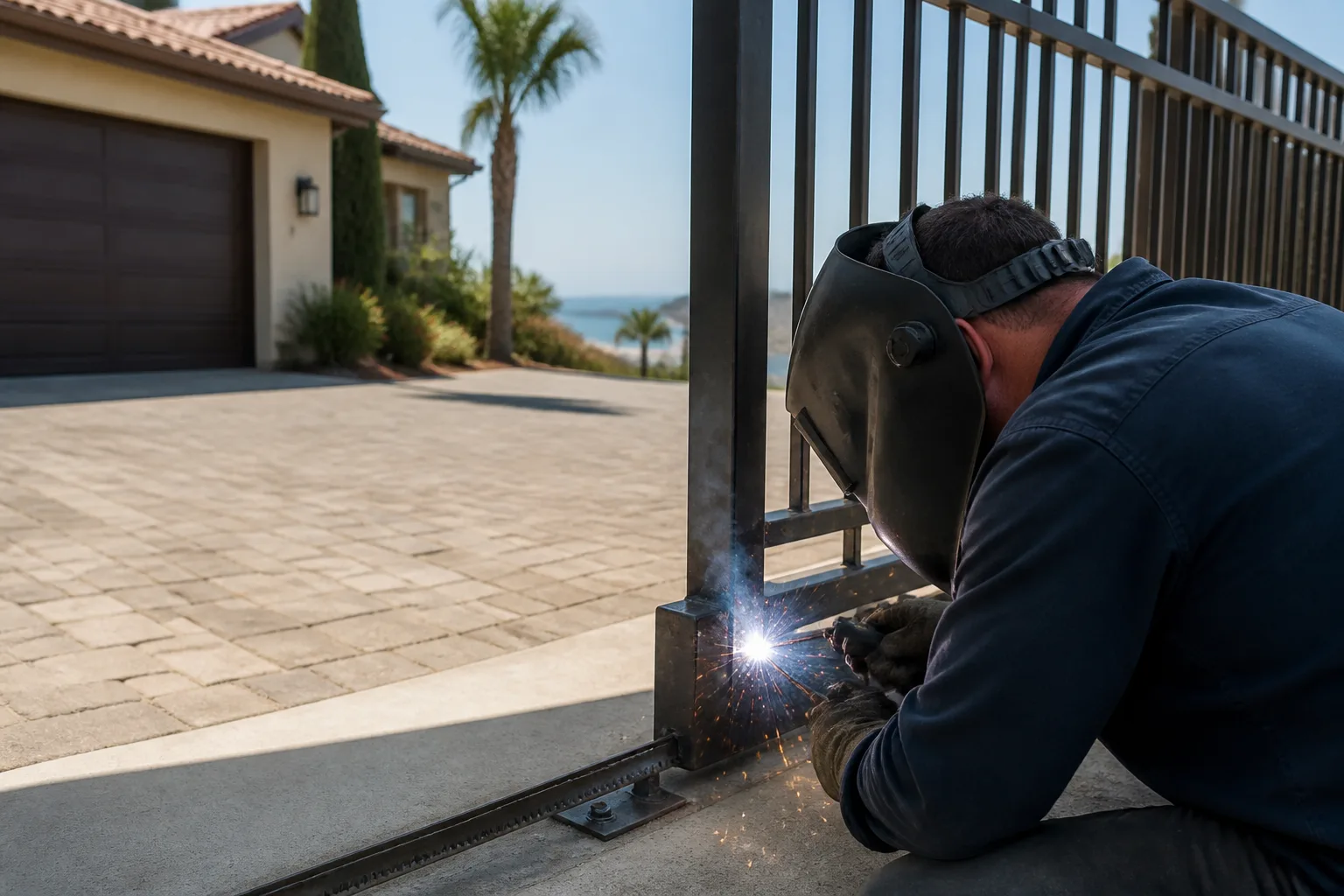
Most gate welding failures in San Diego don’t happen because of bad technique. They happen because of bad preparation, wrong assumptions about parts, and skipped steps after the weld cools. After 20 years of fixing gates other people tried to repair first, we’ve seen the same five mistakes repeat across residential driveways in Rancho Bernardo, commercial properties in Kearny Mesa, and everywhere between. Here’s what actually goes wrong, and how to avoid it.
If you’d rather have a specialist handle it, Sierra Gate Repair San Diego offers free estimates — call (855) 671-2951.
Mistake 1: Welding Over Paint, Rust, or Galvanized Coating
Here’s the hook that should stop you cold: welding a new hinge onto a gate post without grinding down to bare metal means you’re welding to rust. That bead will hold just long enough to make you think it worked. Then the hinge pulls free under load, usually when someone’s pulling through the gate or the motor’s straining against a binding moment.
The problem is fundamental, not fixable with better technique. Paint, mill scale, and rust are all oxides or organics that don’t metallurgically bond with your filler material. Galvanized coating adds another layer of trouble — zinc vaporizes at welding temperatures, creating toxic fumes and porous, weak welds. You’re not joining metal to metal. You’re joining metal to contamination, and contamination has no tensile strength.
What we do on every repair in San Diego, especially with the salt-air exposure near Mission Bay or Coronado, is grind to bright, clean base metal with a flap disc. Not just scuffing — full removal of the compromised layer, usually 1/8 inch back from the weld zone to be sure. Then we weld, then we seal. Skip any step and you’re building on a foundation that isn’t there.
Key point: If you can still see color other than silver-gray bare steel at the weld zone, you’re not ready to strike an arc.
Mistake 2: Replacing the Part Without Finding Why It Failed
A worn gate wheel gets replaced. Six months later, the new wheel is shot too. The homeowner in Scripps Ranch we helped last month had been through three wheels in two years before calling us. The wheel wasn’t the disease. It was the symptom.
Misaligned track, uneven concrete settlement, or a twisted frame all load the wheel asymmetrically. The bearing races wear on one side. The tire develops a flat spot or cracks. You put a new wheel on the same bad geometry, and physics doesn’t care that the part is fresh. It fails the same way, on the same timeline, because the root cause never got addressed.
Same story with hinges that keep tearing out, rack sections that strip repeatedly, or gate motors that burn out annually. We always check:
- Is the gate frame square and level, or has it racked from ground movement?
- Does the gate move freely by hand before any motor is engaged?
- Are mounting surfaces stable, or do they flex under load?
- For automatic systems, is the operator properly sized for gate weight and duty cycle?
We’ve worked on gate motor and opener systems in San Diego across brands like LiftMaster, FAAC, and Linear — and the motor replacement that doesn’t include a full gate mechanical assessment is often a motor replacement that happens again too soon.
Mistake 3: Using Mismatched Hardware Grades
This one looks like it should work. The hinge bolts up. The dimensions match. The finish is similar. But a residential-rated hinge and a commercial-rated hinge that “fit” the same gate can have entirely different load ratings, cycle life, and corrosion resistance.
We see this on commercial properties in San Diego’s industrial corridors — a 6-foot pedestrian gate that got upgraded to automatic operation, but nobody upgraded the hardware to match the new dynamic loads. The motor applies force differently than a human hand. Impact loads, vibration, and the repeated stress of automated cycling will find the weak point in underspecified hardware fast.
Grade 5 versus Grade 8 bolts. Stainless versus zinc-plated in coastal environments. Nylon versus steel bearings in wheels. These aren’t minor variations. They’re the difference between a repair that lasts five years and one that lasts five months. When we source gate parts for a job, we’re matching not just dimensions but duty cycle, environment, and load path. Two decades of supplier relationships across San Diego and national distributors means we can get the right spec, not just the closest match.
Mistake 4: Skipping the Post-Repair Alignment Check Under Power
A gate that swings smoothly by hand can bind violently under motor power. We’ve learned this the hard way so you don’t have to. Manual testing tells you the gate isn’t physically obstructed. It does not tell you how the gate behaves at operating speed, with the acceleration curve and force profile of the specific operator.
We always run the full open-close cycle after any gate repair in San Diego, watching for:
- Binding at the limits of travel where the gate frame flexes into the post
- Motor current draw spikes that indicate mechanical resistance
- Rack and pinion mesh that chatters at speed but looks fine at hand speed
- Limit switch accuracy that drifts under dynamic load
On a BFT system we serviced in Del Mar last year, the gate moved like silk by hand. Under power, the rack whipped slightly at mid-travel, just enough that the pinion lost mesh for a fraction of a second. The motor faulted intermittently. The homeowner had been told they needed a new motor. What they needed was a rack support bracket we’d fabricated and welded on-site — problem solved, motor saved.
Mistake 5: Leaving Hollow Tube Frames Unsealed After Welding
This is the mistake that doesn’t show up for two or three years, which makes it easy to miss. Hollow steel tube gate frames have open ends. Welding repairs create penetration holes, grind marks, and heat-affected zones where the original mill coating is burned away. Water gets in. Not dramatic water — irrigation overspray, morning condensation, the occasional rain that San Diego does get in winter months.
Inside the tube, there’s no air circulation. Water sits. The interior surface rusts from the inside out. By the time you see bubbling paint or a soft spot on the exterior, the interior wall has significant section loss. We’ve cut open frames in La Jolla and Clairemont that looked solid outside and were paper-thin inside.
After every welding repair, we seal tube ends with welded caps or quality silicone. We touch weld penetrations and grind marks with cold galvanizing compound or epoxy primer. For gates in irrigated landscapes — which is most of San Diego’s residential areas — this step is non-negotiable. The frame you save is your own.
When to Call a Pro
Some gate welding and parts replacement is genuinely within reach of a capable homeowner with a grinder, a MIG welder, and patience. But if you’re dealing with automatic gate systems, structural frame damage, or any repair where a failure could cause injury or property damage, the cost of getting it wrong exceeds the cost of getting it right the first time.
Frank and his team have been fixing gates for 20 years — they’ve seen these problems before. From a bent frame we can weld on-site to a full smart-access system, it’s all handled in one call. We work on virtually every major gate brand, including LiftMaster and FAAC — no referrals, no guesswork. 375 customers and a 4.9-star average — the kind of trust that’s built one repair at a time.
The Bottom Line
Clean metal, root-cause diagnosis, matched hardware, powered alignment verification, and sealed frames. These five disciplines separate lasting repairs from repeated callbacks. Most gate welding that fails in San Diego fails on preparation or follow-through, not on the weld itself.
If you’re in San Diego and need help with gate parts, welding, or any gate repair, Sierra Gate Repair San Diego offers free estimates — call (855) 671-2951.
Frequently Asked Questions
You can weld a gate hinge yourself if you have proper equipment, understand the safety requirements, and grind to clean base metal first. However, automatic gates and heavy commercial gates involve significant injury risk if the repair fails under load, so we recommend a trained gate specialist for those applications. Call (855) 671-2951 for a free estimate — we’ll tell you honestly if it’s a DIY-appropriate fix.
Repeated failure of the same component almost always indicates an underlying alignment, loading, or sizing problem that hasn’t been addressed. The part is a symptom, not the root cause. We diagnose the full mechanical system before replacing parts so the failure cycle actually stops.
Most on-site gate welding repairs in San Diego range from $180 to $450 depending on access, material thickness, and whether frame straightening or parts fabrication is needed. Structural repairs requiring extensive disassembly run higher. We provide exact quotes after inspection — call (855) 671-2951 to schedule.
A properly prepared, welded, and sealed gate repair should last 10 to 15 years in San Diego’s climate, assuming normal use and no ground settlement or vehicle impact. The most common reason we see premature failure is welding over contaminated or unsealed surfaces, which cuts lifespan to 2 to 4 years.
Written by Frank Delgado, Founder & Lead Installer at Sierra Gate Repair San Diego, serving San Diego since 2006.
Need Gate Repair Help?
Call Sierra Gate Repair San Diego — licensed & insured, here with fast after-hours help in San Diego.
(855) 671-2951