
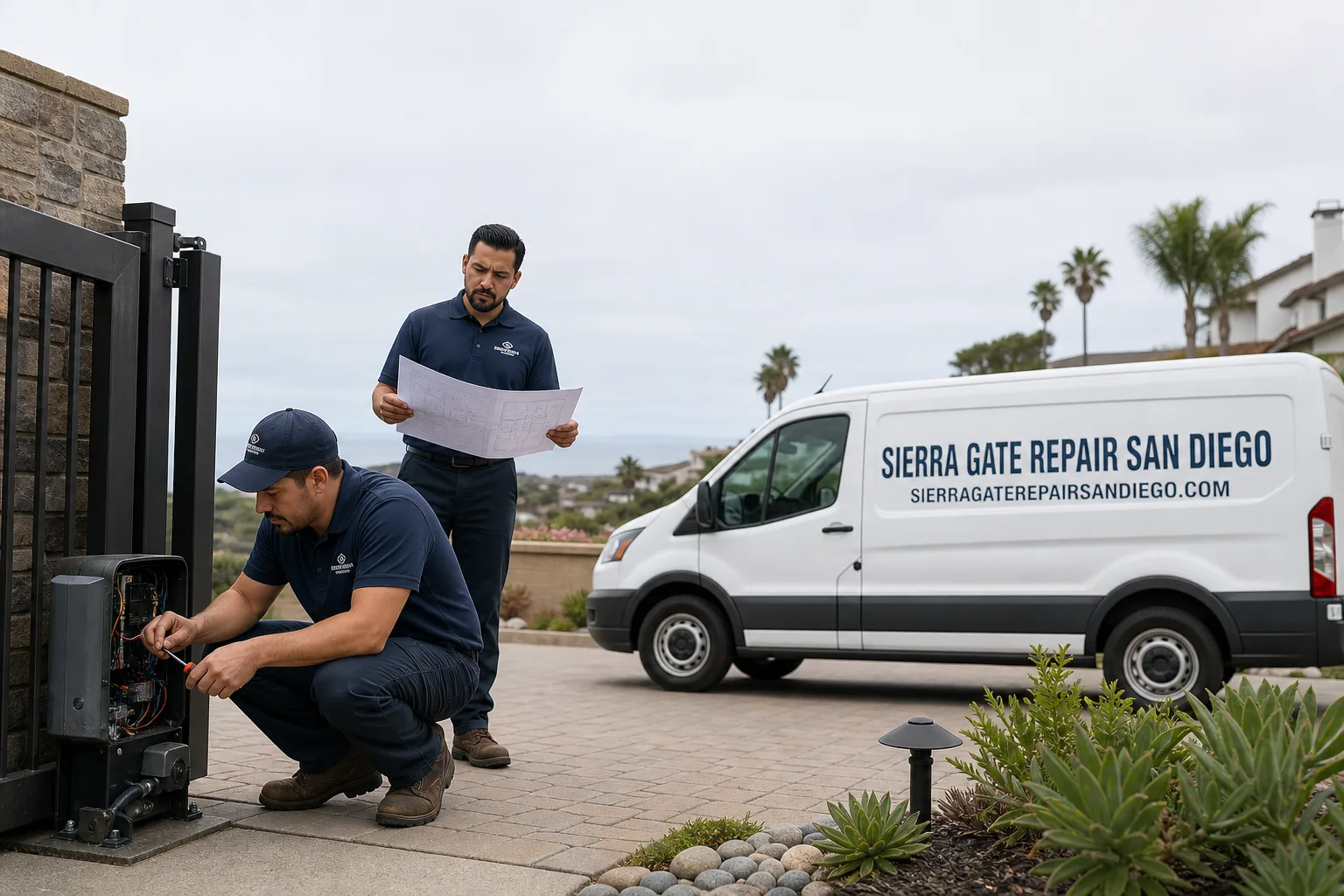
Fast, Reliable Gate Access Control Across Chinatown
Gate access control repair and installation in Chinatown typically runs $280–$650 for keypad or card-reader systems, with most service calls completed same-day when you call before noon. We’re familiar with the tight alleyways and aging brick buildings that define this neighborhood, and we plan every Chinatown job knowing that Grant Avenue traffic and narrow passages like Ross Alley affect how we reach you. Call (855) 671-2951 for a free estimate.
Chinatown’s commercial density means gate problems aren’t a tomorrow problem. When your roll-up security gate won’t open for morning deliveries, or your keypad stops recognizing codes before a tenant shift change, you need someone who understands the neighborhood’s specific constraints. We’ve been servicing gates in San Francisco for 20 years, and Chinatown’s mix of historic masonry, salt-air exposure, and alley-only access presents challenges that inland neighborhoods simply don’t face.
Why Sierra Gate Repair San Diego Is Chinatown’s Preferred Gate Access Control Company
Frank Delgado, our founder, still runs the jobs himself. When you call us for gate access control in Chinatown, you get 20 years of focused gate expertise on-site, not a rotating crew figuring things out as they go. That matters on a 1920s brick building where standard anchors pull out of crumbling mortar, or when a keypad needs reprogramming on a system that’s been patched together by three different companies over a decade.
Our 375 verified reviews averaging 4.9 stars reflect work across San Francisco’s most demanding neighborhoods. Chinatown property managers call us back because we’ve solved failure modes — salt-seized springs, corroded opener chains, masonry anchors that failed within months — that generalist competitors hadn’t seen before.
Response time to Chinatown averages 45–90 minutes from initial call during business hours, though Grant Avenue congestion and alley access can add 10–15 minutes if we need to stage from Broadway or California Street. We always confirm the building address and alley situation when you call, so we’re not circling Waverly Place with a van that won’t fit.
Our Gate Access Control team carries a deep inventory of keypad modules, card readers, and video intercom components specifically for the brands we see most in Chinatown’s commercial buildings: LiftMaster, FAAC, BFT, and Linear. We don’t order parts after we arrive. That saves you a second trip charge and a second day of compromised security.
Our Gate Access Control Services in Chinatown
Keypad Entry Systems
Keypad entry is the workhorse of Chinatown’s commercial corridors. Every ground-floor business on Grant Avenue and Stockton Street depends on reliable code access for employees, deliveries, and cleaning crews. We install and repair standalone keypads, hardwired systems, and keypad-intercom combinations. On a recent service call near California Street, we replaced a corroded keypad whose contacts had failed from salt-moisture infiltration, then reprogrammed the master code and all ten user codes while the tenant finished their morning setup.
Typical keypad repair or replacement in Chinatown: $280–$420 for standard commercial units, $480–$650 for heavy-duty or multi-code systems with audit-trail logging.

Smart Access Integration
Smart access — phone-based entry, remote unlocking, time-restricted digital keys — is increasingly requested by Chinatown property owners modernizing older buildings. We integrate smart modules with existing gate operators from FAAC, BFT, and Linear, or spec complete systems for new installations. The challenge in Chinatown is often the building’s electrical infrastructure: 1907–1930s wiring wasn’t designed for networked devices, and conduit runs through unreinforced masonry require care. We’ve retrofitted smart access onto century-old gates by routing low-voltage cable through existing chase ways rather than drilling new penetrations that compromise structural integrity.
Smart access add-on to existing gate: $340–$580. Full smart system with new operator: $1,200–$2,400.

Video Intercom Systems
Video intercoms serve the residential units above Chinatown’s retail floors, where tenants need to verify visitors before buzzing them through a shared gate. We install vandal-resistant surface-mount units that withstand street-level exposure, with night-vision capability for the fog-darkened evenings common near the Embarcadero. Cable runs from gate to upper floors often require creative routing in these old buildings; we’ve fished wire through original ventilation shafts and across rooftop parapets when interior paths were sealed by retrofit work.
Video intercom installation in Chinatown: $680–$1,400 depending on floors served and cable routing complexity.

Phone Entry & Card Reader Systems
Phone entry systems — which ring a landline or cell phone when a visitor presses a call button — remain popular for smaller Chinatown buildings without full-time management. Card readers suit larger commercial properties with high employee turnover, since lost cards are cheaper to replace than rekeying or reprogramming codes. We service both magnetic stripe and proximity (RFID) readers, with stock on hand for Viking and DoorKing units that we see frequently in San Francisco’s commercial market.
Phone entry repair: $240–$380. Card reader replacement: $320–$520.

What happens when you call
- 1
A real person answersNo phone trees — you reach a local pro.
- 2
You get an upfront price rangeHonest numbers before anyone is dispatched.
- 3
A background-checked tech heads outLicensed & insured, dispatched right away.
- 4
You approve before work beginsNothing starts until you say go.
Trusted Brands We Service in Chinatown
We work on virtually every major gate operator brand, including FAAC, BFT, and Linear — the three we encounter most in Chinatown’s commercial installations. Our van stocks replacement chains, gears, control boards, and access modules for these systems, which means most Chinatown repairs don’t wait on parts. For Viking and DoorKing card readers, we carry common credential formats and can clone or program new cards on-site. Frank and his team have been fixing gates for 20 years; they’ve seen how these specific brands fail in salt-air conditions, and they spec components accordingly. When we install a new opener in Chinatown, we default to galvanized or stainless hardware unless the customer specifically requests otherwise. The extra material cost is modest. The avoided callback from a seized spring six months later is substantial.
Common Gate Access Control Problems We See in Chinatown Homes
- Salt fog seizes iron roll-up slats and torsion springs within 2–3 years. The marine layer funneling through the Broadway and Columbus corridor deposits a measurable salt-moisture film on exposed metal. We’ve replaced springs on Chinatown security gates that were installed just 28 months prior, with corrosion patterns that would take 5–6 years to develop in the Mission District.
- Aging unreinforced masonry crumbles under standard gate hardware anchors. The post-1906 brick and mortar in Chinatown’s mixed-use buildings often lacks the compressive strength for wedge anchors or sleeve bolts. We use epoxy-injected threaded rod or through-bolted backing plates on masonry installations, which adds labor but prevents the catastrophic pullout that sends a heavy gate swinging free.
- Soft-story retrofit steelwork conflicts with existing gate tracks and brackets. Many Chinatown buildings have received or are receiving mandatory seismic upgrades. New moment frames and shear walls sometimes occupy the exact wall space where a gate track was mounted, or reduce the clear opening height. We’ve relocated track systems and shortened gate leaves to accommodate retrofit work without full replacement.
- Tight alleyways force hand-carry-only service, limiting parts that can reach the job. On Ross Alley, Waverly Place, and Spofford Alley, our techs park on Grant Avenue or Broadway and walk everything in. That means no ladder truck, no bulky welding rig, and no 8-foot torsion spring carried casually. We pre-plan alley jobs with the customer to confirm what’s feasible and stage larger components from the nearest accessible street.
Pricing for Gate Access Control in Chinatown, CA
| Service | Typical Range in Chinatown |
|---|---|
| Keypad repair/replacement | $280–$420 |
| Smart access add-on | $340–$580 |
| Video intercom installation | $680–$1,400 |
| Card reader replacement | $320–$520 |
| Phone entry repair | $240–$380 |
| Full smart system with operator | $1,200–$2,400 |
Chinatown pricing runs roughly 10–15% above inland San Francisco neighborhoods for jobs involving masonry anchoring or corrosion-damaged hardware replacement. The salt-air environment means we often replace more components than initially visible — a seized spring frequently indicates a compromised opener chain, rusted hinges, and pitted track. We quote everything we find, with line-item breakdowns, before starting work. Estimates are free. Call (855) 671-2951 to schedule.
We Also Serve Cities Near Chinatown
We travel throughout San Francisco for gate access control work, including the Mission District, Noe Valley, and Visitacion Valley. Each neighborhood presents different building eras, access conditions, and corrosion exposure. The Mission’s warmer, drier microclimate extends spring life significantly compared to Chinatown’s salt-fog pattern. Noe Valley’s hillside grades require different gate operator torque specs. Visitacion Valley’s industrial stock uses heavier-duty systems. Wherever you are, we adjust our approach to what that specific location demands.
Serving Chinatown, CA — Our Local Coverage Area
We’re based in the Chinatown area and know this community well. Use the map below to see our service coverage — if you’re nearby, we can almost certainly help.
FAQs — Gate Access Control in Chinatown
Yes, we install smart keypads in Chinatown’s narrow alleys, but we pre-plan the job to confirm we can hand-carry all components from the nearest accessible street. For Ross Alley, Waverly Place, or Spofford Alley, we typically stage from Grant Avenue or Broadway and walk in tools, the keypad module, and any necessary cable. Call (855) 671-2951 and we’ll verify alley access before scheduling — estimates are free.
In Chinatown’s salt-air environment, inspect torsion springs annually and expect replacement every 2–3 years rather than the 5–7 years typical inland. The marine layer accelerates corrosion on uncoated steel springs, and a seized spring can burn out your opener motor or warp the gate frame. We use galvanized springs in Chinatown as standard, which extends service life by roughly 30%. Call (855) 671-2951 to schedule a corrosion inspection.
Usually yes, but we survey the retrofit steelwork before quoting. New moment frames and shear walls sometimes occupy wall space where gate tracks or control boxes were originally mounted. We’ve relocated track systems and shortened gate leaves to accommodate retrofit work without full replacement. The key is planning around the existing structural modifications rather than fighting them. Call (855) 671-2951 and Frank will assess your specific building.
Yes, we service gates on Spofford Alley, Ross Alley, and Waverly Place. These alleys are too narrow for our service van, so we hand-carry tools and parts from the nearest cross street. That limits the size of components we can bring in — no ladder truck, no bulky welding rig — but we’ve completed keypad replacements, hinge repairs, and opener reprogramming in all three alleys. Call (855) 671-2951 to confirm your specific alley’s access.
We recommend FAAC and BFT for heavy commercial use in Chinatown, with Linear as a strong mid-duty option. All three offer sealed control enclosures and corrosion-resistant hardware options that outperform standard configurations in salt-fog conditions. The brand matters less than the specification: we always order galvanized or stainless components, sealed bearings, and marine-grade control boards for Chinatown installations. Call (855) 671-2951 to discuss which system fits your gate’s duty cycle and budget.
Written by Frank Delgado, Owner at Sierra Gate Repair San Diego, serving San Diego since 2004.