
Mighty Mule Gate Repair in San Diego: A Homeowner’s Guide
Mighty Mule gate repair in San Diego typically costs $180–$420 depending on whether the issue is a failed battery, a misaligned limit switch, or a corrupted control board. Most repairs are completed same-day because the parts are widely available, though coastal installations near Point Loma or Pacific Beach often need extra attention for corrosion and solar panel efficiency. If you’re staring at a gate that won’t close or a remote that suddenly stopped working, you can reach Sierra Gate Repair San Diego at (855) 671-2951 for a free estimate.
Mighty Mule built its name on DIY accessibility. The FM350, MM560, and newer smart models ship with straightforward instructions, and a handy homeowner can get one running over a Saturday. But that same simplicity creates a trap: when something fails, it’s easy to assume the fix must be equally simple. In our 20 years of gate work across San Diego, we’ve found that Mighty Mule problems are misdiagnosed more often than any other brand we service, including commercial systems like DoorKing or Viking. The symptoms look generic, but the root causes are specific to how these operators handle power, limits, and accessory integration.
Why San Diego’s Climate Hits Mighty Mule Operators Harder Than Most
The battery is the heart of any Mighty Mule system, and San Diego’s temperature swings are harder on batteries than our mild reputation suggests. Inland neighborhoods like Rancho Bernardo, El Cajon, and Santee see summer days push 95°F, then drop 30 degrees overnight. Those heat cycles accelerate sulfation in the sealed lead-acid batteries Mighty Mule uses. A battery that tests fine at 10 a.m. can fail to deliver enough cranking amps at 6 p.m. when the gate is actually cycling.
Coastal areas present the opposite problem. The marine layer that rolls through La Jolla, Del Mar, and Ocean Beach carries salt mist that corrodes battery terminals and charging connections. We’ve opened control boxes in Cardiff-by-the-Sea where the battery tray was crusted white but the battery itself was fine. The owner had already replaced two batteries unnecessarily because the real issue was a corroded charging circuit.
Solar panel installations compound this. Mighty Mule’s 5-watt and 10-watt panels work well when clean, but San Diego’s coastal haze, combined with the fine dust that blows east from the desert, coats panels in a film that cuts output by 30–40% without looking dirty. A gate that worked fine in March starts stalling in June, and the homeowner assumes the motor is dying. Usually, the panel just needs cleaning and the battery needs a full charge cycle to recover.
What to check: Test battery voltage under load, not at rest. Clean solar panels monthly if you’re within 3 miles of the coast. Inspect terminal connections for white or green corrosion, especially on installations more than 4 years old.
Reading the Blink Codes Most Homeowners Never Notice
Every Mighty Mule control board has a small LED that flashes in specific patterns to indicate faults. Most owners don’t know this exists because it’s buried in the manual and the board is usually mounted inside a weatherproof housing. But those blink codes are the fastest path to an accurate diagnosis.
Here’s what we’ve learned from hundreds of San Diego service calls:
- 1 blink: Low battery or inadequate charging. Check panel output and battery load voltage.
- 2 blinks: Obstruction detected during close cycle. Often a misaligned limit switch, not an actual obstruction.
- 3 blinks: Motor overload. Could be mechanical binding, a failing gearbox, or a gate that’s become heavier due to rust or debris.
- 4 blinks: Control board fault. Usually requires board replacement, though we’ve revived a few by clearing corrupted accessory programming.
- 5 blinks: Remote or keypad communication failure. Often resolved by reprogramming, but can indicate a failing receiver.
We pulled a Mighty Mule out of a garage in Scripps Ranch last month where the owner had lived with 2-blink reversals for six months. He’d adjusted the obstruction sensitivity dial repeatedly, which helped briefly, but the real issue was a limit switch arm that had slipped 3 millimeters out of position. Fifteen minutes with a screwdriver fixed what he’d been fighting with for half a year.
The Limit Switch Problem That Tricks Everyone
Mighty Mule gates reverse or stop short more than any other symptom we see. The factory default for close-force sensitivity is conservative, which is good for safety but frustrating when a gate starts sagging on its hinges or the ground settles slightly. Homeowners crank the force adjustment higher, which masks the real problem until the operator eventually faults out or damages the gate structure.
The mechanical limit switches on FM260, FM350, and MM560 models use a small nylon arm that rides against a cam. Over time, vibration loosens the set screw. The arm drifts. The gate thinks it’s fully closed when it’s still 8 inches open, or it tries to drive past the physical stop and triggers the overload protection.
Adjusting the limit switch properly requires cycling the gate to each extreme, loosening the cam screw, and resetting the arm position, then verifying with 3–5 full cycles. It’s not difficult, but it’s finicky. Set the arm 2 millimeters off, and the gate will either slam the stop or reverse randomly. We’ve had customers in Poway and Chula Vista tell us they “tried everything” before calling, and the fix was literally a single screw adjustment they’d attempted but abandoned.
When to call: If you’ve adjusted limits twice and the gate still behaves inconsistently, there’s likely mechanical wear in the cam or the switch itself is failing. Continuing to force-adjust risks burning out the motor or bending the gate frame.
Accessory Add-Ons: Where DIY Wiring Goes Wrong
Mighty Mule operators are popular because they accept accessories, keypads, intercoms, and additional remotes without proprietary restrictions. That openness is also their vulnerability. The control boards on older FM-series units, especially pre-2018 models, have limited memory for accessory codes and no protection against wiring faults.
We’ve seen three common mistakes in San Diego homes:
- Power draw overload: Adding a video intercom and keypad to the same accessory terminals pulls more current than the board’s 24V auxiliary output can supply. Voltage sags, codes corrupt, and the board starts ignoring remotes randomly.
- Ground loop issues: Running low-voltage accessory wire parallel to 120V conduit induces interference. The gate opens by itself at 2 a.m., or the keypad works only when the landscape lighting is off. We traced one phantom opening in Encinitas to a sprinkler control wire bundled with the gate low-voltage run.
- Reverse polarity on older boards: Pre-2016 Mighty Mule boards have no reverse-polarity protection on accessory terminals. Connect a keypad backward and the board’s EEPROM can corrupt, requiring a full factory reset or replacement.
If you’re adding anything beyond a second remote, it’s worth verifying the accessory’s current draw against the board’s auxiliary rating. For integrated intercom or smart-access systems, we typically recommend upgrading to a dedicated access control setup rather than piggybacking on the operator’s limited capacity.
When Repair Stops Making Sense
There’s an honest point where Mighty Mule repair becomes throwing good money after bad. We’ve done three repairs on the same operator for customers who were attached to the unit, and we don’t enjoy taking that money when we know a replacement is the smarter call.
Consider moving on rather than repairing again if:
- The control board has been replaced once and fails again within 18 months. Repeated board failure usually means an underlying electrical issue, power surge damage, or moisture intrusion that replacement won’t solve.
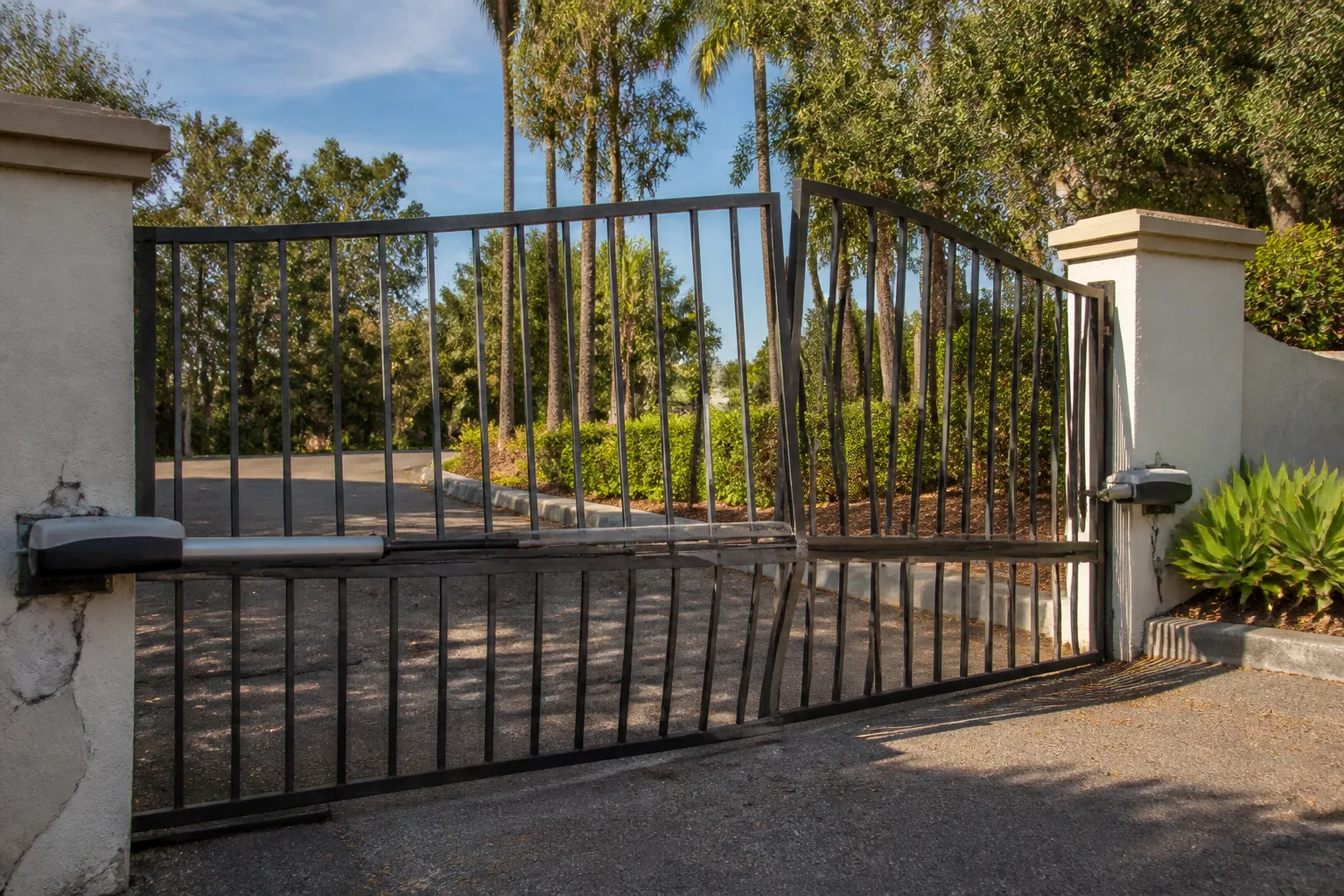
- The gate itself is structurally degraded. A Mighty Mule operator on a rusted, sagging frame will fail repeatedly because the mechanical load exceeds design limits. Weld the frame first, then evaluate the operator.
- You’re adding significant access control, cellular connectivity, or commercial-duty cycling. Mighty Mule builds residential-grade equipment. For a San Diego property with 20+ daily cycles, a Linear or commercial-grade system will outlast two or three Mighty Mule units.
- The total of repairs in the past 3 years exceeds 60% of a new operator cost. At that point, reliability matters more than sunk cost.
We install plenty of Mighty Mule units for customers who want simple, solar-capable automation without complexity. We also replace them with more robust systems when the use case demands it. The difference is matching the hardware to the actual job, not just selling what’s familiar.
Related Services in San Diego
If your Mighty Mule issue turns out to be a bent frame, failing hinges, or a gate that’s dragging on settled concrete, our gate repair work in San Diego covers structural fixes, welding, and full operator replacements. We also handle new gate installation when the existing gate has reached end-of-life alongside the operator.
What happens when you call
- 1
A real person answersNo phone trees — you reach a local pro.
- 2
You get an upfront price rangeHonest numbers before anyone is dispatched.
- 3
A background-checked tech heads outLicensed & insured, dispatched right away.
- 4
You approve before work beginsNothing starts until you say go.
The Bottom Line
Mighty Mule operators are straightforward until they’re not. San Diego’s climate stresses batteries and solar charging in ways that mimic motor failure. The built-in diagnostic blink codes are underused. Limit switch drift causes more “broken” gates than actual mechanical failure. And accessory additions can push older boards past their design limits.
The good news: most of these issues resolve quickly with correct diagnosis. The bad news: misdiagnosis leads to unnecessary parts replacement and escalating frustration.
Key takeaways:
- Test batteries under load, not at rest voltage
- Clean solar panels monthly near the coast
- Learn your board’s blink code before buying parts
- Limit switch adjustment is precise; small errors cause big symptoms
- Accessory additions need verified power budgets
- Three repairs in three years suggests replacement is smarter
If you’re in San Diego and your Mighty Mule isn’t behaving, Sierra Gate Repair San Diego offers free estimates. Frank Delgado still runs the jobs personally. Call (855) 671-2951 and we’ll diagnose it properly the first time.
Frequently Asked Questions
Most Mighty Mule repairs in San Diego run $180–$420. A battery replacement and solar panel cleaning at the low end, control board replacement toward the higher end. Structural welding or hinge repair adds $150–$300 depending on material. Call (855) 671-2951 for an exact quote, estimates are free.
Nine times out of ten, this is a limit switch that’s slipped out of adjustment, not an actual obstruction. The close-force sensitivity dial is a temporary workaround, not a fix. Proper limit switch recalibration takes 15–20 minutes with the right sequence. If you’ve tried adjusting it twice without success, the cam or switch itself may be worn.
Some newer Mighty Mule models have Bluetooth or Wi-Fi modules available. Older units can accept basic keypads and remotes within the board’s accessory limits. For integrated smartphone control, video verification, or multiple-user access, we typically recommend a dedicated access control system rather than stretching the Mighty Mule platform past its design intent.
With proper maintenance, 7–10 years is realistic for residential use. Coastal installations may see 5–7 years due to corrosion stress. Inland heat-cycling areas like El Cajon or Lakeside often need battery replacement at year 3–4 but can keep the operator itself running longer. Commercial-duty cycling, 15+ times daily, shortens lifespan significantly regardless of climate.
Written by Frank Delgado, Founder & Lead Installer at Sierra Gate Repair San Diego, serving San Diego since 2006.
Need Gate Repair Help?
Call Sierra Gate Repair San Diego — licensed & insured, here with fast after-hours help in San Diego.
(855) 671-2951