Top Signs You Need Gate Repair Service — Don’t Ignore These
A gate that needs repair usually announces itself through specific mechanical and electrical signals — sagging, grinding, intermittent operation, or slower travel times — weeks before it fails completely. In San Diego’s salt-air climate, corrosion accelerates these warning signs on hinges, terminals, and control boards faster than most homeowners expect. If you’d rather have a specialist read the signals for you, Sierra Gate Repair San Diego offers free estimates — call (855) 671-2951.
The gate that “just needs a little push” to close has already told you something is wrong — you just haven’t learned to listen to it yet. We’ve been fixing gates across San Diego for 20 years, and the pattern never changes: the homeowner who catches the early whisper saves a few hundred bucks. The one who waits for the shout often needs a full motor replacement or new frame. Here are the signs we look for on every service call, and what they’re actually telling you.
1. Your Gate “Works Fine Most of the Time” — The Intermittent Failure Trap
This is the most misunderstood signal in gate repair. A gate that operates correctly nine out of ten cycles isn’t “mostly okay.” It’s giving you a precise diagnostic window.
Intermittent failures point to specific, identifiable problems:
- Failing safety sensors — moisture, spider webs, or misalignment cause random obstruction errors
- Loose wire connections — vibration from gate travel slowly works terminals free, especially where salt air has started corrosion
- Overheating control board components — works when cool, fails after repeated cycles on hot San Diego afternoons
- Weak battery in solar or backup systems — sufficient voltage for one cycle, insufficient for the next
The pattern matters more than the frequency. Note when it fails: morning or afternoon? First cycle or after repeated use? During damp marine layer conditions or dry Santa Ana winds? That detail cuts our diagnostic time in half when you call. We’ve traced “random” failures to a single oxidized terminal on a Linear operator in Point Loma — the salt air had crept in so gradually the homeowner thought the gate was just moody.
Urgency level: Schedule within 1–2 weeks. These problems worsen unpredictably and often fail completely during heavy use periods.
2. Slower Travel Speed — The “It Still Opens” Fallacy
A gate that takes 30% longer to open or close than it did last year isn’t merely aging gracefully. It’s drawing excess amperage, straining the motor, and marching toward burnout.
Gate operators are designed to move a specific load at a specific speed. When friction increases — dry rollers, bent track, debris in the guide, or a sagging frame pulling the gate off-alignment — the motor compensates by working harder. The control board may not throw an error code yet. The gate still reaches full open. But the motor windings are running hotter, the gearbox is wearing faster, and the capacitor is cycling beyond its design limits.
We’ve replaced BFT operators in San Diego that failed prematurely because the homeowner waited six months while the gate slowed from 12 seconds to 18 seconds per cycle. The motor didn’t die from old age. It died from overwork caused by a $45 roller replacement that was needed months earlier.
Time your gate. If travel has increased by more than 3–4 seconds, something mechanical is resisting movement. Find it now, or buy a motor later.
Urgency level: Schedule within 2–3 weeks. Motor damage accumulates progressively.
3. Grinding, Screeching, or Clunking Sounds
Gates should operate with a low mechanical hum, not a metal-on-metal symphony. Each sound signature points to a specific failure mode:
- Grinding — dry or failing rollers, debris in the track, or worn gear teeth in the operator
- Screeching — metal hinge pins binding due to corrosion or lack of lubrication; extremely common in coastal San Diego where marine layer deposits salt on exposed steel
- Clunking or banging — loose gate hardware, cracked welds, or a failing limit switch causing hard stops
- Clicking without movement — relay or capacitor failure in the control board; motor receives signal but lacks starting torque
Sound changes are often the first detectable symptom. A homeowner in La Jolla called us last month because her Viking operator had developed a “new rattle.” We found a mounting bolt had completely backed out of the concrete footing, allowing the entire operator to shift with each cycle. Another week and the actuator arm would have snapped from misalignment.
Urgency level: Grinding or screeching warrants 2–3 week scheduling. Clunking or banging — especially with visible gate movement or shake — schedule within days. Clicking without movement often indicates imminent total failure.
4. The Gate Reverses Mid-Travel or Won’t Stay Closed
This is where we move from maintenance concern to genuine safety issue. A gate that reverses unexpectedly can strike a vehicle, a pet, or a person. The causes are specific and require prompt correction:
- Obstruction sensitivity set too high — correctable adjustment, but misdiagnosed by generalists who replace parts unnecessarily
- Damaged or misaligned safety loops/photo eyes — common after landscaping work or vehicle bumps
- Mechanical binding creating false resistance signal — the operator interprets friction as obstruction
- Failing limit switches — gate doesn’t know where “closed” actually is
San Diego’s hillside properties compound this issue. Gates installed on slopes experience uneven load distribution as they travel, which can trigger obstruction responses on perfectly healthy operators. We’ve adjusted Ghost Controls systems in Del Mar where the solution wasn’t a new motor — it was recalibrating force settings for the actual terrain, not the factory default.
Never override safety systems to “fix” reversal problems. The safety features are working; the underlying fault is what needs addressing.
Urgency level: Schedule immediately. This is a safety-critical failure mode.
5. Visible Corrosion, Rust, or Salt Deposits — San Diego’s Special Accelerator
Our marine layer isn’t just morning fog. It’s airborne salt that deposits on every exposed metal surface, accelerates galvanic corrosion between dissimilar metals, and infiltrates electrical connections that look sealed.
Here’s what early salt damage actually looks like:
- White or green powder on battery terminals and wire connections — oxidation in progress, resistance increasing
- Pitting on stainless steel hinge pins — yes, even “stainless” corrodes in coastal exposure; 316-grade holds up better than 304, but neither is immune
- Swollen or cracked wire insulation near ground level — capillary moisture wicking followed by salt crystallization
- Gate frame bubbling at weld points — the heat-affected zone is metallurgically different and corrodes preferentially
Inland competitors don’t see this pattern as frequently. We’ve developed specific preventive routines for coastal San Diego properties: dielectric grease on all terminals, quarterly hinge inspection cycles, and strategic material selection when we fabricate replacement components on-site. Our welding capability means we can repair a corroded frame corner without waiting for a factory replacement that may not match the existing gate anyway.
Urgency level: Inspect monthly if within 2 miles of the coast. Schedule professional evaluation when corrosion first becomes visible — surface rust becomes structural failure faster in our climate.
6. The Five-Point Walkaround: What You Can Check Yourself
Before you call anyone, including us, walk your gate system with this checklist. It takes five minutes and gives you real information:
- Track and rollers: Look for flat spots on rollers, debris in the track, or gaps between roller and rail. Spin each roller by hand — roughness or catching means replacement.
- Hinges and pivot points: Wiggle the gate manually (power off). Any play at hinge barrels? Grease should be present, not dried or washed away. In San Diego, check the bottom hinge especially — splash and irrigation accelerate corrosion there.
- Operator mounting: Verify all bolts are present and tight. Look for cracks in the concrete footing or shifting of the pad. Check the actuator arm for bends or binding at full extension.
- Electrical connections: With power off, inspect the control box interior if accessible. White or green deposits on terminals? Wire nuts loose? Ant damage (surprisingly common — they nest in the warmth)?
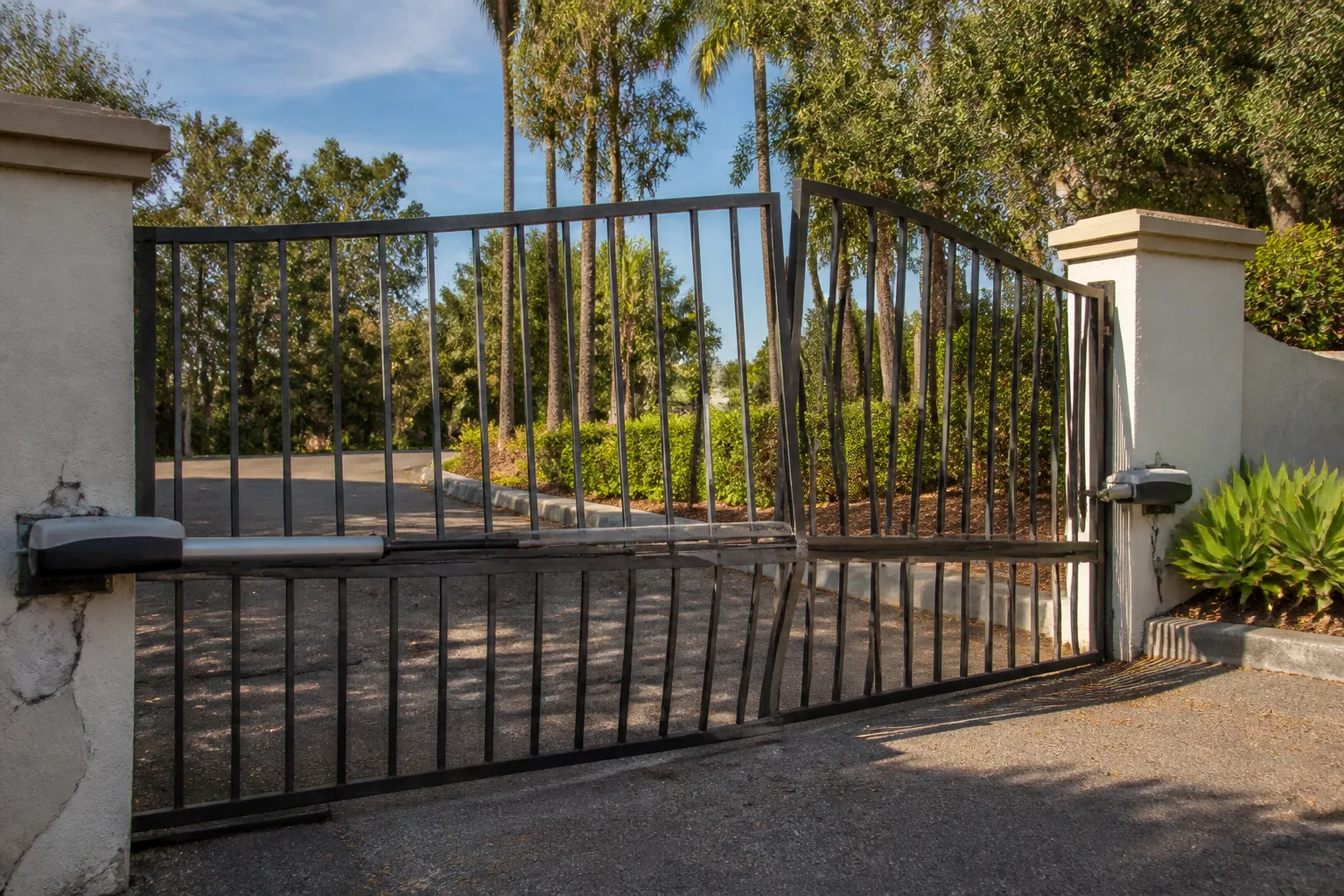
- Gate frame and welds: Follow the perimeter with your eyes. Cracks often start at corners and stress points. Push gently against the gate — flex or rattle indicates structural looseness.
Document what you find. Photos help. Then call someone who knows what the findings mean.
When to Call a Pro — And What to Expect
If your walkaround reveals any safety issue — reversal problems, structural cracks, sparking, or a gate that won’t stay locked — stop using the gate and call for service. For slower-degradation issues, you’ve bought yourself time to choose the right specialist.
When you call, expect specific questions about brand, symptoms, and age. A gate technician who doesn’t ask these is guessing. At Sierra Gate Repair in San Diego, Frank still runs the diagnostic calls personally — 20 years of exclusively gate work means he’s seen your specific failure mode before, on your brand, probably in your neighborhood.
Related services: If your inspection suggests the gate itself is sound but the operator is failing, our gate motor and opener service in San Diego covers diagnosis through replacement across all nine major brands we support. For gates beyond repair, new gate installation in San Diego includes on-site welding and custom fabrication.
Key Takeaways
- Intermittent failures are more diagnostic than total failures — note the pattern before calling
- Slower travel means the motor is overworking; time your gate to catch this early
- Sound changes are early warnings with specific mechanical meanings
- Reversal and safety failures require immediate professional attention
- San Diego’s salt air accelerates corrosion — coastal properties need more frequent inspection
- The five-point walkaround gives you actionable information and prevents unnecessary service calls
The Bottom Line
Gates don’t fail without warning. They whisper, then they speak, then they shout. The $200 repair happens when you’re listening during the whisper. The $2,000 replacement happens when you wait for the shout.
We’ve been doing this long enough to know that every homeowner thinks their situation is unique. It usually isn’t. What is unique is having someone who recognizes the pattern, sources the right part, and fixes it without selling you what you don’t need. That’s what 20 years and 375 reviews averaging 4.9 stars represents — not perfection, but consistency.
If you’re in San Diego and your gate is showing any of these signs, call (855) 671-2951 for a free estimate. We’ll walk the five points with you, tell you what’s actually wrong, and handle the repair from a bent frame we can weld on-site to a full smart-access system — all in one call.
Frequently Asked Questions
Most residential gate repairs in San Diego range from $180 for hinge and roller service to $650 for operator component replacement, with full motor replacement typically $800–$1,400 depending on brand and access requirements. Commercial systems and specialized brands like FAAC or BFT run higher due to parts cost. Call (855) 671-2951 for an exact quote — estimates are free.
Many motor issues are repairable: failed capacitors, damaged wiring, stripped limit gears, and control board component failure can all be addressed without full replacement. We replace motors when the stator windings are burned, the gearbox is cracked, or repair parts are obsolete. Frank evaluates each unit individually — we’ve saved San Diego homeowners thousands by repairing Viking and Linear operators that other companies wanted to replace entirely.
Temperature-dependent failure almost always indicates a weakening electronic component — capacitors lose capacity when hot, solder joints expand and break connection, or battery voltage drops under thermal load. Note the exact temperature and failure pattern when you call; it accelerates diagnosis significantly. This is one of the most common calls we get during San Diego’s late-summer heat waves.
If the frame is structurally sound and the operator is a current or recent model, repair is almost always more economical. Replacement becomes cost-effective when the frame has multiple corrosion points, the operator is discontinued with no parts availability, or you’re upgrading to modern access control. We don’t sell new gates to people who need repairs — call (855) 671-2951 and we’ll tell you honestly which path makes sense for your specific gate.
Written by Frank Delgado, Founder & Lead Installer at Sierra Gate Repair San Diego, serving San Diego since 2006.
Need Gate Repair Help?
Call Sierra Gate Repair San Diego — licensed & insured, here with fast after-hours help in San Diego.
(855) 671-2951